News / Announcements / AINI brings together government, industry and technology speakers at Microsoft Peru to discuss Peru in 2027
AINI brings together government, industry and technology speakers at Microsoft Peru to discuss Peru in 2027
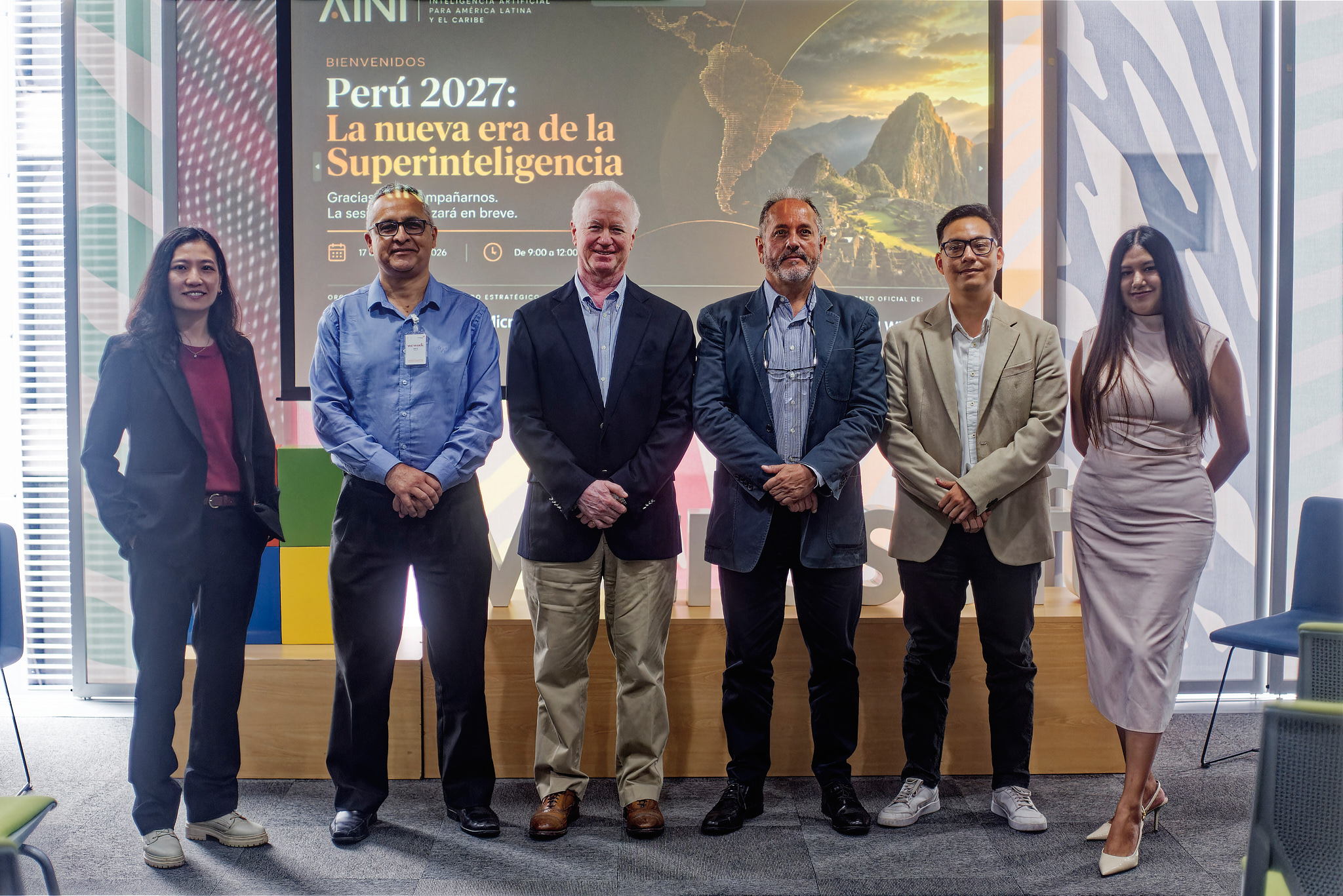
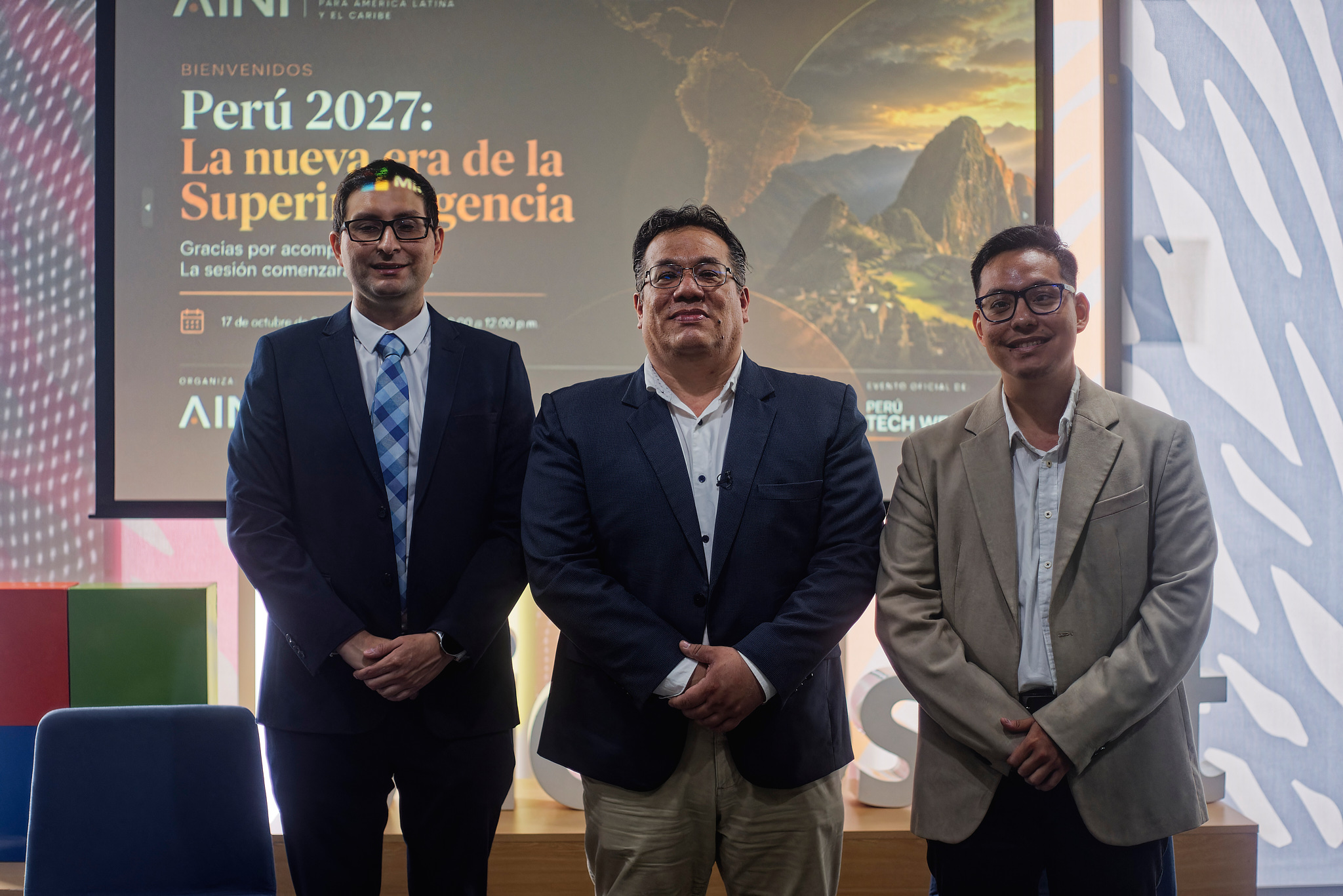
On October 17, 2026, AINI held “Perú 2027: La nueva era de la Superinteligencia,” an official Peru Tech Week 2026 event, with speakers from Microsoft, ProInnóvate, the National Society of Industries, APESOFT, EficiencIA Legal and the ACM.
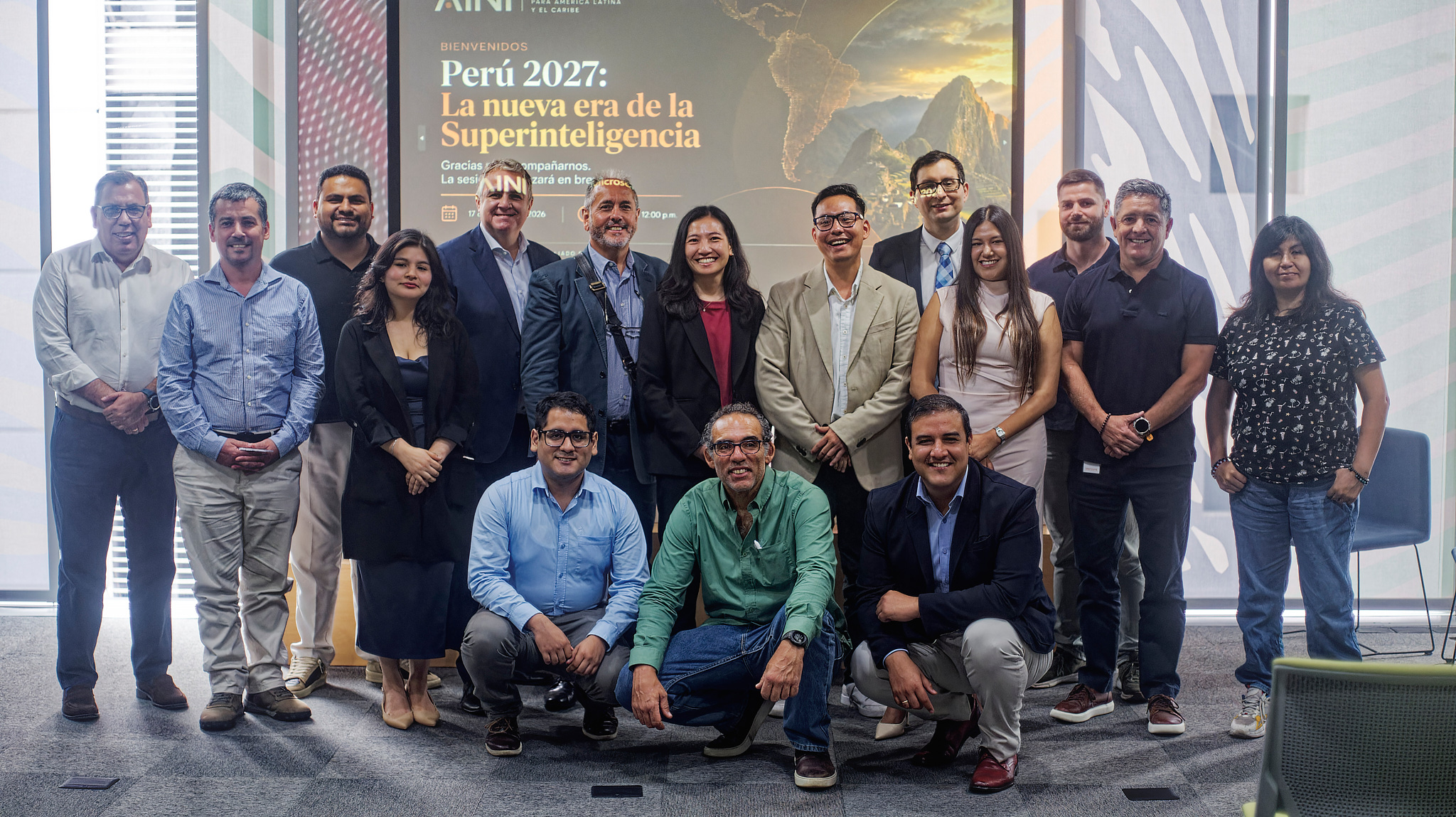
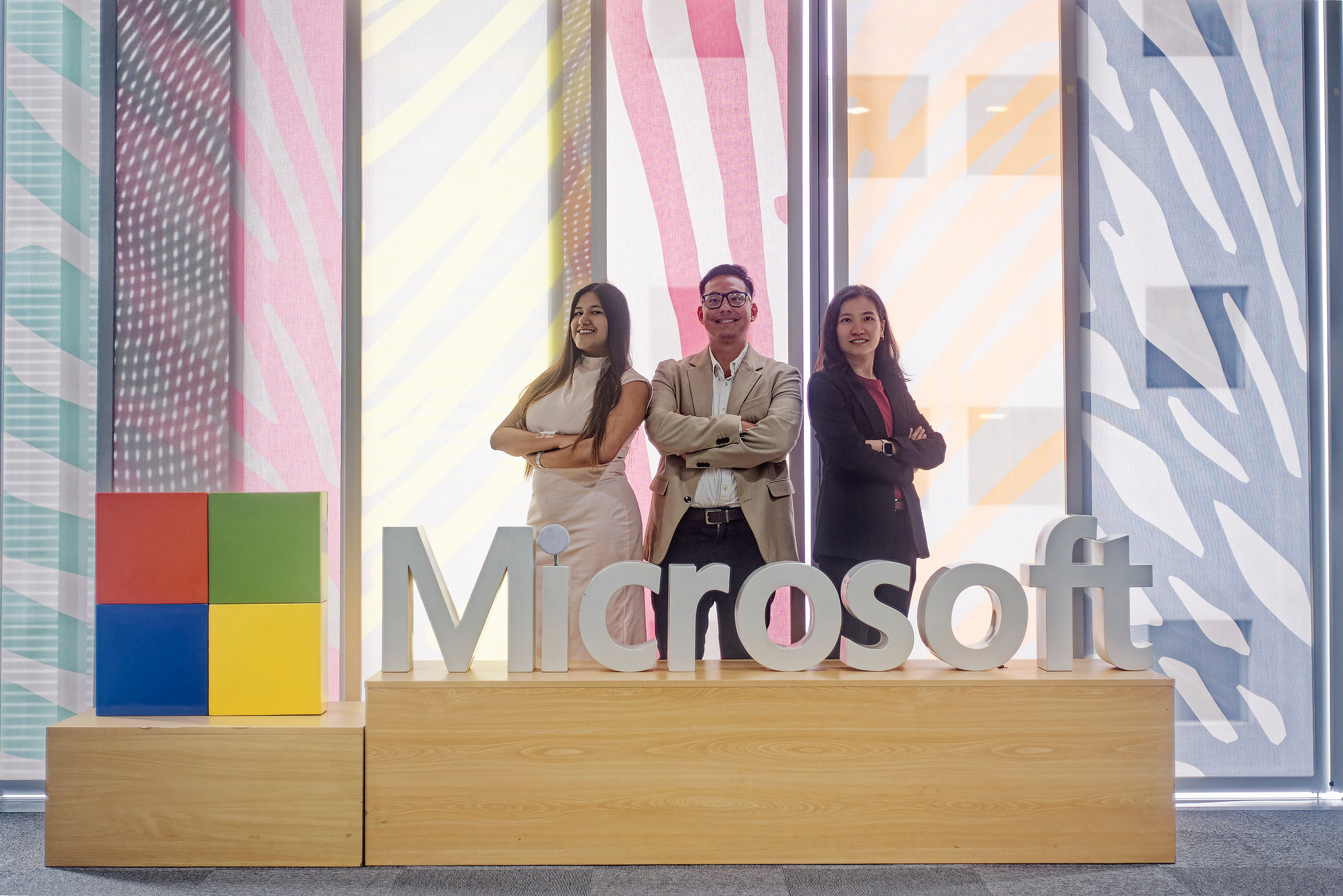
On October 17, 2026, AINI — Super Intelligence Institute for Latin America and the Caribbean held “Perú 2027: La nueva era de la Superinteligencia,” an official Peru Tech Week 2026 event, in the Sala Inca at Microsoft Peru, in San Isidro, Lima. The session, from 9:00 a.m. to noon, brought together 74 people in the room: speakers from Microsoft, ProInnóvate, the National Society of Industries (SNI), the Peruvian Software Association (APESOFT), EficiencIA Legal and the Association for Computing Machinery (ACM), as well as representatives of business associations, banking, startups, academia, partners and the institute's organizing team. AINI will publish videos of the session on its YouTube channel.
Dennis Vivas, president of AINI, framed the purpose of the session:
Dennis Vivas said the morning brought together technology leaders, government and business associations to discuss how intelligence is transforming competitiveness in Peru and the decisions that must be made before 2027.
Opening: questions before tools
Dennis Vivas, president of AINI, welcomed attendees and introduced APESOFT as institutional ally and Impacta Ahora and Horizonte Blockchain as ecosystem allies. The opening remarks were given by Ying Cheung, AINI's Asia Pacific Partnership Director, and by Emilio Navarro, vice president of AINI, who joined remotely from the United States and thanked Microsoft Peru for hosting the gathering.
Navarro argued that adopting a tool does not by itself transform an organization, and that before asking what an AI model can do, one has to ask what problem needs solving, who benefits, and who answers when an AI-assisted decision has consequences. He recalled the limit set by the AINI Constitution: no decision that decisively affects a person's work, credit, freedom or reputation should be delegated entirely to an algorithm without identifiable human responsibility.
Emilio Navarro, vice president of AINI, told the audience that they do not need to have all the answers, but they do need to ask the right questions and learn together.
Microsoft: the impact is still to come
In the first fireside chat, “The New Era of Super Intelligence. ¿Qué significa para el Perú?”, Dennis Vivas spoke with Alex Le Bienvenu, Microsoft's director of Data & Artificial Intelligence for Latin America. Le Bienvenu compared AI to the internet: its impact on the economy will follow a hockey-stick curve, and, according to Microsoft research and development estimates he cited, that jump would come within 7 to 10 years, compared with 15 or 20 for earlier technologies.
According to Le Bienvenu, the organizations that get a return from AI start from the four or five problems their board and senior management have already identified, not from projects chosen for novelty. He pointed to two common obstacles: data scattered across silos, which limits an agent's accuracy, and the use of generative AI for tasks already solved by traditional machine learning models, which are deterministic. As an example, he mentioned a predictive maintenance model whose accuracy fell from 98.5% to about 60% when it was replaced with generative AI.
He also recommended that companies give their employees AI tools under the company's control, instead of having them use personal subscriptions with company data, and that they have at least one person dedicated exclusively to applying AI within the organization.
Alex Le Bienvenu of Microsoft said he believes artificial intelligence is a net positive for humanity, and that everyone will have a role in making it responsible, setting limits and watching how it works.
AINI's vision for Peru in 2027
Roberto Vargas, executive director of AINI, presented the institute's vision from Bogotá. He proposed putting the creation of national capabilities at the center of the country's technology agenda, above the ideological debate over economic growth, and cited as a sign the investment in data centers in Peru, which by his figures will exceed US$1 billion this year.
Vargas set out three lines of action for 2027: a cooperation table between the public and private sectors, starting in Peru and extending to Latin America and the Caribbean; the AINI Summit, on April 15, 2027, at the Lima Convention Center, with parallel sessions to agree with the public sector on an agenda centered on national capabilities; and capability building, both within companies and for individuals.
As background, Vargas recalled that, at his proposal, the Government created the Presidential Strategic Secretariat in late August, a senior management body of the Presidential Office responsible for proposing the General Government Policy and government priorities to the Presidency of the Republic, coordinating them and monitoring them. It was created by Supreme Decree No. 122-2026-PCM of August 27, 2026.
ProInnóvate: the State as a user and funder of AI
In the second fireside chat, “Estado actual y perspectivas de la IA en el Perú 2027”, Adolfo Moran, founder and CEO of EficiencIA Legal, spoke with Sergio Rodríguez Soria, executive director of ProInnóvate, the Ministry of Production program that funds innovation and entrepreneurship projects across the country.
Rodríguez explained that the program already uses AI in narrowly defined internal processes, such as assigning external evaluators to the projects that apply, and that a growing share of the projects it funds use AI as the engine of their business model. He named as a challenge bringing these tools to traditional micro and small businesses, and invited those present to apply to the program's calls, which approve about one in five projects and are expected to open mostly in January and February 2027.
Sergio Rodríguez Soria, executive director of ProInnóvate, said the program is funding a great many projects that now use artificial intelligence as the engine of their business model, and that he is confident there will be many more in 2027.
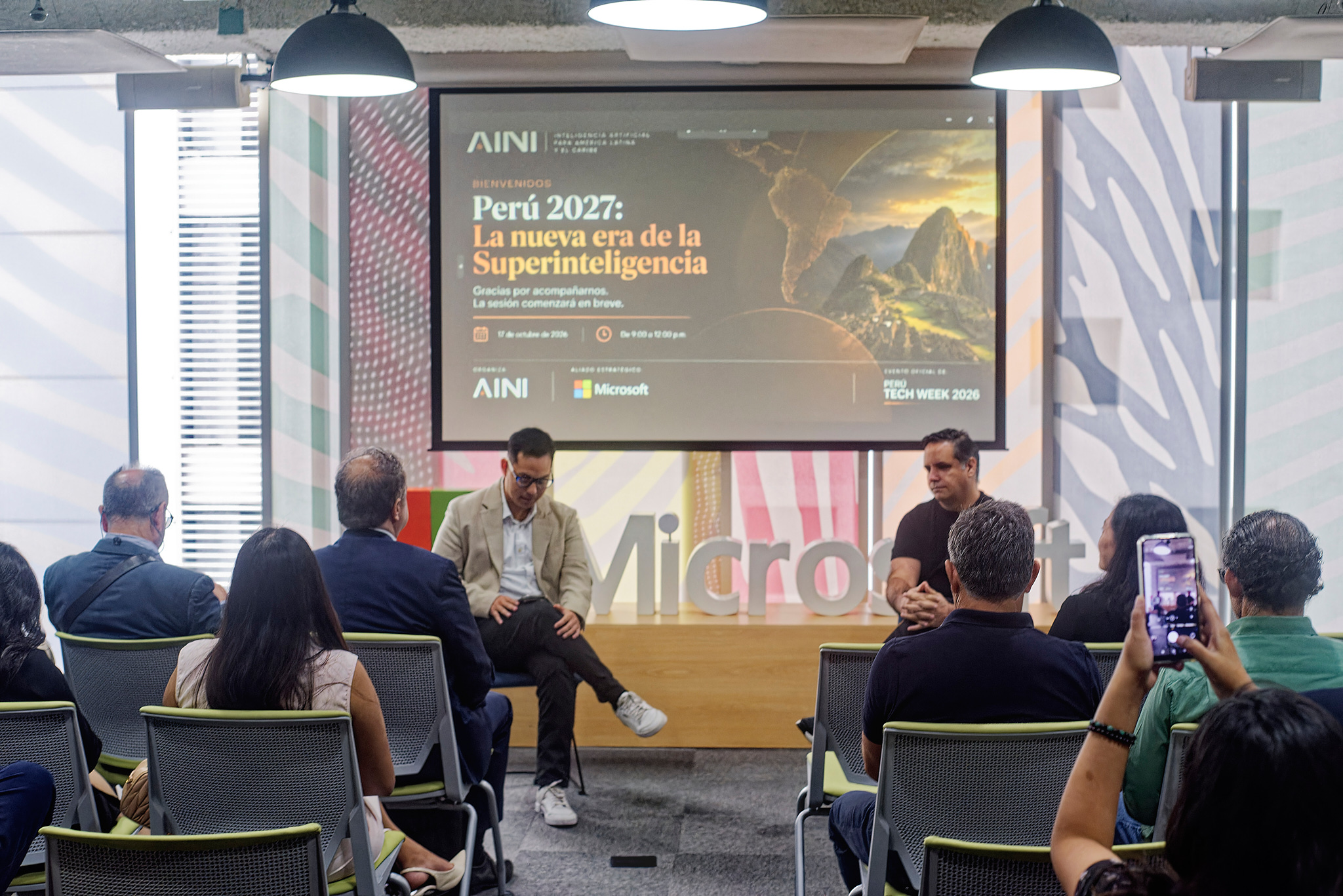
Panel: from technology users to technology creators
The panel “Oportunidades y Riesgos en la IA para América Latina,” moderated by Ernesto Cuadros, ACM Distinguished Visitor Speaker, brought together Enrique Mesones, president of APESOFT, and Antonio Ramírez, director at the SNI, where he leads the automation, robotics and ICT committee. The discussion started from a premise set by the moderator: Peru needs to move from using technology to creating it.
Mesones, who represented Peru in APEC forums this year, described how ecosystems in Asia connect universities, government, companies, startups and capital so that research reaches the market, and contrasted that with the small number of Peruvian patents that are ever commercialized. He also mentioned a two-way growth and innovation corridor with Asia, launched a few weeks ago in Medellín, so that Peruvian companies and startups can find markets and investment in that region.
Ramírez cited the 2025 Global Innovation Index, in which, he said, Peru ranks 80th out of 139 economies, and noted that AI adoption among Peruvian companies reaches 17.3%, but that only 13% of them integrate it into their core processes. For industry, he proposed applying AI close to the machines and with low latency, along with university curricula with more electives that are updated at the pace of technology.
Cuadros noted that the country has only four computer science programs built to international standards—one of them still being implemented—and argued that training that talent is what attracts development centers of global technology companies to the country.
Closing
The closing remarks were given by Miranda Rojas, AINI's Latin America Partnership Director and a member of its Board of Directors. The session ended with a group photo of speakers and organizers. AINI will continue the conversation at the AINI Summit, on April 15, 2027, at the Lima Convention Center.