
News / Economy / The Free Trade Agreement between Peru and Hong Kong is now in force: what it opens in financial services and information technology
The Free Trade Agreement between Peru and Hong Kong is now in force: what it opens in financial services and information technology
The agreement has been in force since September 1, 2026, while the investment agreement with Hong Kong is still awaiting signature. AINI reviewed the text of the treaty and its schedules of commitments, with a focus on financial services and information technology.
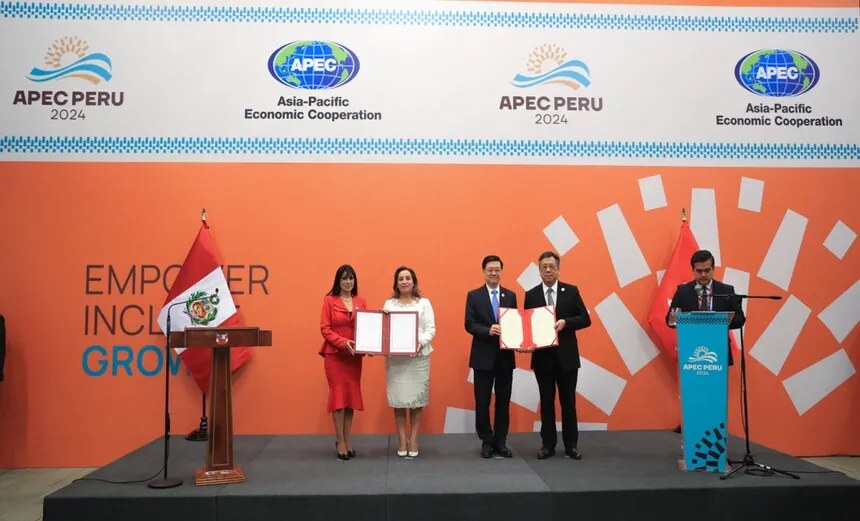
The Free Trade Agreement between the Republic of Peru and Hong Kong, China has been in force since September 1, 2026. It was signed in Lima on November 15, 2024, during the APEC Economic Leaders’ Meeting, and Peru ratified it through Supreme Decree No. 030-2026-RE, published on July 15, 2026. In 2025, Peru exported US$237.8 million to Hong Kong and imported US$28.6 million.
The investment agreement, not yet signed
At Hong Kong FinTech Week x StartmeupHK 2026, in which AINI took part, Algernon Yau, Hong Kong’s Secretary for Commerce and Economic Development, said his government is working toward signing an investment agreement with Peru. He did not give a date. In August, the Hong Kong government had reported that negotiation of the Investment Promotion and Protection Agreement (IPPA) had concluded and that it will be signed once both sides complete their internal procedures. Peru’s Ministry of Economy and Finance had expected the signing to take place in the first half of 2026.
The distinction matters. The FTA guarantees national treatment to those who establish themselves in the other economy and prohibits imposing performance requirements on them. However, it expressly excludes expropriation, the minimum standard of treatment and transfers, and it does not provide for investor-state arbitration. Those protections are the subject of the IPPA.
Financial services
Financial services have their own chapter. Banks, insurers and other financial institutions of one party that establish themselves in the other receive national treatment and most-favoured-nation treatment. They cannot be required to have senior management of a particular nationality, and only a minority of their board can be required to be local or resident. Each regulator retains broad room to adopt measures for prudential reasons.
For services sold from abroad, the opening is limited. Peru allows, from Hong Kong, insurance for maritime and air transport and for goods in transit, reinsurance, and the related intermediation and consulting; in banking, only financial data processing—with prior authorisation from the regulator where required and under Peru’s personal data law—and advisory services without intermediation. Hong Kong allows, from Peru, non-life insurance, reinsurance, insurance intermediation and auxiliary services, financial leasing, guarantees and financial data processing. There is no commitment for offering deposits, lending, payments, securities trading or asset management from the other economy: that requires establishing a local presence with a local licence.
Two rules are relevant for fintech companies. Payment card networks of one party may process transactions in the other from abroad, with local registration or representation. And each party must allow a new financial service if it would allow its own institutions to supply it without changing the law. On the other hand, the free data flow rules of the electronic commerce chapter do not apply to financial institutions; the parties must open that discussion within the first three years the agreement is in force.
Information technology services
The services chapter works through a negative list: everything is open except what each party reserved. For computer and related services, Peru set no market access limitations on cross-border supply, consumption abroad or commercial presence, and Hong Kong listed no specific reservations for these services. Except in the services each party reserved, neither may require a local office or residence to sell a service remotely. The movement of personnel remains subject to each party’s immigration and labour rules.
The electronic commerce chapter adds five commitments: no customs duties on electronic transmissions; cross-border transfer of data, including personal data, is allowed when it is part of a business; local servers cannot be required as a condition for operating; the source code of mass-market software cannot be required; and the validity of electronic signatures and contracts is recognised. Each party may depart from the data and server rules for a legitimate public policy objective, as long as it does not discriminate or restrict more than necessary.
Goods: almost the entire tariff universe
In goods, Hong Kong eliminated tariffs on all Peruvian products from day one. Peru freed 91.3% of its 8,003 tariff lines upon entry into force and will reach 98.3% by the end of the schedule. The exceptions are concentrated in textiles, apparel and footwear: 600 of the 696 lines that were not freed from the first year, with phase-out periods of up to 17 years. In addition, 89 textile lines were excluded from tariff elimination: they pay the general tariff in force and will be renegotiated in the fifth year.
The texts of the agreement are published at acuerdoscomerciales.gob.pe and on the website of Hong Kong’s Trade and Industry Department.
Would your organization like to join AINI?
We work with companies, governments, universities and civil society organizations across Latin America and the Caribbean. Let's talk about membership, education partnerships or sponsoring CIAL 2027, in Lima in April 2027.
Become a partner