
News / Announcements / Hong Kong FinTech Week 2026, day 1: the takeaways from governments, regulators and global banks
Hong Kong FinTech Week 2026, day 1: the takeaways from governments, regulators and global banks
AINI was present at the opening of Hong Kong FinTech Week x StartmeupHK 2026, one of the world’s largest fintech gatherings. Government, regulators and major banks agreed on one point: artificial intelligence, tokenization and trust have moved from pilots into the real economy.
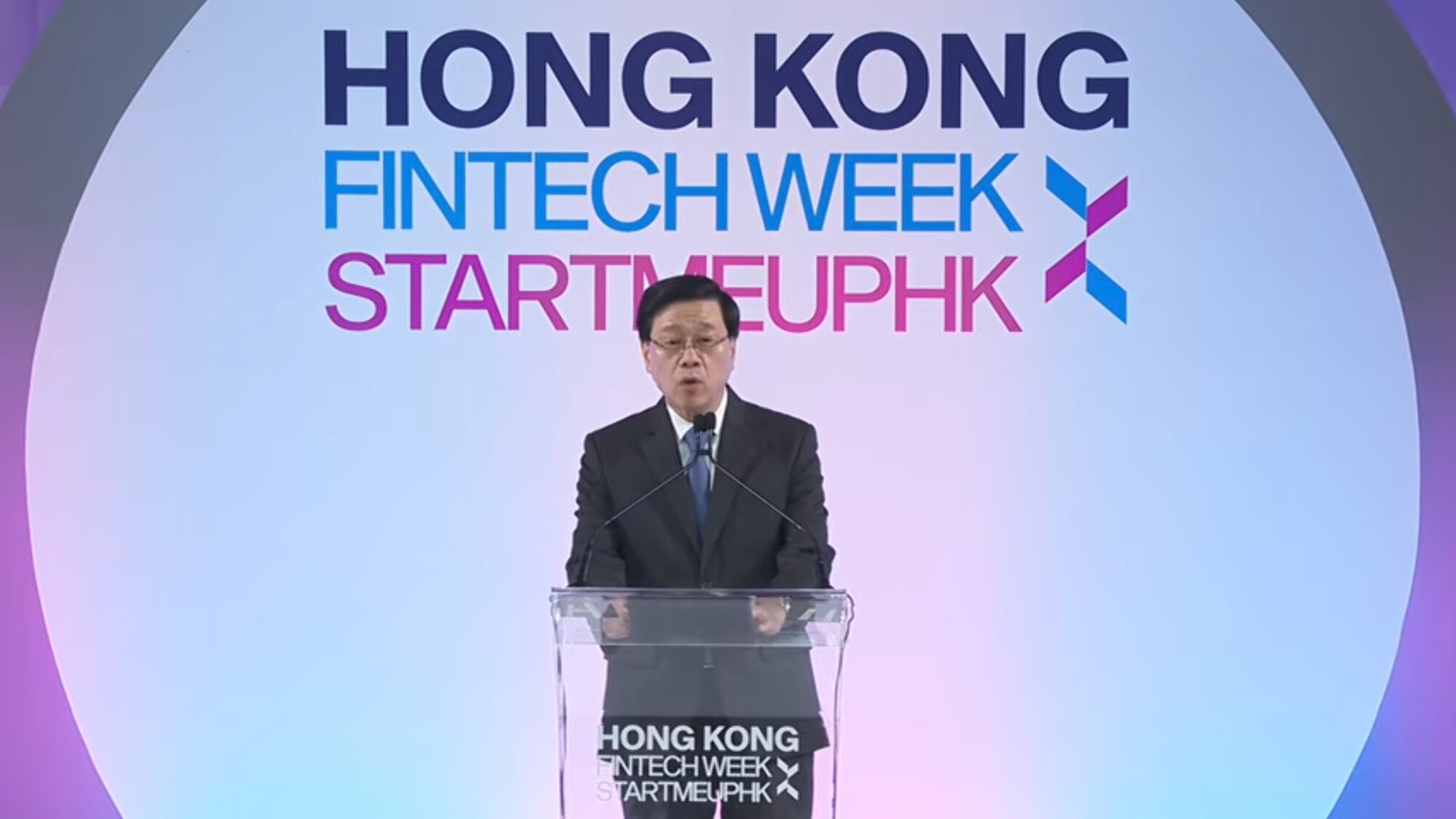
AINI took part in the first day of Hong Kong FinTech Week x StartmeupHK 2026. The day brought together government leaders, financial regulators and executives from some of the world’s largest institutions. That participation is part of AINI’s work to connect Latin America and the Caribbean with the centers where the rules of AI applied to finance are being defined today. The event drew some 45,000 attendees, more than 1,000 speakers and about 800 exhibitors.
AINI’s agenda on day 1
In addition to following the main panels, AINI held bilateral meetings with leaders of companies from Asia, North America and global networks. They work in AI applied to finance, payments, cybersecurity and media.
Iris Wu, CFA, Chief Strategy Officer of Rabyte Technologies, an AI-powered investment research platform headquartered in Shanghai with an office in Hong Kong.
Dicky Wong, CEO of Syber Couture and convenor of the Quantum Computing Specialist Group of the Hong Kong Computer Society. That same day he took part in the panel on the impact of quantum computing on encryption.
Jackie Lau, Vice President, Client Leadership at WPP Media, the WPP group’s global media and advertising network.
Erik Le, CEO of Twendee, a Vietnamese software development and AI agent company.
Shawn W. McNaughton, Director of Sales at Apaylo, a Canadian payments company.
These conversations seek to build bridges between Asia and Latin America and the Caribbean on three fronts: AI in the financial sector, payments infrastructure and readiness for post-quantum cryptography. These are the same topics that dominated the day’s agenda. AINI will follow up on each of these connections in the coming weeks.
These are the most relevant announcements and lessons from the day.
Public sector: certainty as a strategy
John K. C. Lee, Hong Kong’s Chief Executive, opened the event with a clear message. In a world of uncertainty, Hong Kong wants to offer certainty. He presented the city’s first five-year plan, aligned with China’s 15th Five-Year Plan. Its big bet is the Northern Metropolis, an innovation hub next to Shenzhen that will be home to 2.5 million people and create more than 500,000 jobs.
Paul Chan, the Financial Secretary, organized the agenda around three priorities: efficiency as the engine, inclusion as the purpose and trust as the foundation. The Commercial Data Interchange (CDI) has already facilitated more than 125,000 SME loan applications worth nearly HK$110 billion and lowered their rates by about 36 basis points. The government’s fourth tokenized green bond raised HK$20 billion and was settled in part with tokenized deposits.
AI agents may carry out tasks, but responsibility remains with the institution.
With that sentence, Chan summed up the government’s position.
Regulators: clear rules, controlled testing and global cooperation
The Hong Kong Monetary Authority (HKMA) made three key announcements: 24/7 interbank settlement with tokenized central bank money, within Project Ensemble; Project Sage, a forum with the industry to define safeguards for “agentic finance”; and a post-quantum cryptography transition toolkit for the entire local banking sector.
The Securities and Futures Commission (SFC) published its AI readiness survey of large firms: 100% of firms already use AI, 55% have agentic AI in production or in pilot, and 80% plan to expand it next year. The SFC also approved the world’s first 24/7 secondary market for tokenized money market funds. Hong Kong now has 17 tokenized retail products, with US$1.3 billion in assets. In addition, the government announced that before the end of the year it will introduce a bill to regulate custody of and advice on digital assets.
The Insurance Authority presented its “AI Plus” strategy, which seeks to use AI to create new products and not just to do better what already exists. It includes new AI guidance with six principles and a climate risk portal to price insurance more accurately.
The international perspective also carried weight. The Banque de France confirmed that it already offers tokenized central bank money for wholesale transactions. The BIS warned of the risk of many institutions relying on a single AI model. And Ashley Alder, chair of the UK’s FCA, summed up the regulatory consensus: accountability cannot be automated.
Private sector: from efficiency to new business models
HSBC announced an AI and Emerging Technology Institute in Hong Kong with HKUST, which will open in 2027. The bank also reported that its retail Hong Kong dollar stablecoin passed 50,000 users in its first week and that its AI fraud system cut fraud by 70%.
Standard Chartered argued that commerce between AI agents will not be able to work without digital money. It already operates its own Hong Kong dollar stablecoin.
Citi showed concrete results: underwriting four times faster and account opening cut from 75 to 15 minutes. Even so, only 4% of its wealth clients would fully delegate their investments to AI.
Franklin Templeton explained that its tokenized money market fund calculates yield every second and operates 24/7. It also said that its 1,000 AI agents cut the preparation of a client proposal from 18 hours to 14 minutes.
Tencent presented a “payment ontology” that detects scam patterns in hours, not weeks. MiniMax warned that with AI agents, personalized advice will stop being an expensive and exclusive service.
Five lessons from day 1
1. Agentic AI is already in production and is moving faster than the capacity to regulate it. The regulators’ response is not to prohibit. It is to require that there always be an accountable human and to test solutions in sandboxes.
2. Tokenization has reached its inflection point. Hong Kong accounts for about 70% of the tokenized bonds issued worldwide this year. The challenge now is liquidity and interoperability.
3. Agentic commerce brings AI and tokenization together. AI agents need digital money, clear authorization rules and shared trust standards.
4. Systemic risk is shifting toward technology. The cloud, AI models and AI-powered cyberattacks are today regulators’ main concerns. October’s PHP vulnerability was an example cited several times.
5. Trust is the competitive advantage. Everyone has access to the same models. What sets an institution apart is its data, its governance and its accountability to the client.
What it means for Latin America and the Caribbean
Hong Kong shows that financial innovation grows faster when there are clear rules from the start: sandboxes, licensing regimes and accountability frameworks for AI. For our region, the lessons are direct. We need shared data infrastructure that makes SME lending easier, early preparation for post-quantum cryptography and regional cooperation against cyber risks that no longer respect borders.
At AINI, we will closely follow the coming days of the event and share what we learn to accelerate responsible and competitive AI adoption in Latin America and the Caribbean.
Would your organization like to join AINI?
We work with companies, governments, universities and civil society organizations across Latin America and the Caribbean. Let's talk about membership, education partnerships or sponsoring CIAL 2027, in Lima in April 2027.
Become a partner