
News / Announcements / Hong Kong FinTech Week 2026, day 2: sovereignty, capital and the test of trust
Hong Kong FinTech Week 2026, day 2: sovereignty, capital and the test of trust
On the second day of Hong Kong FinTech Week x StartmeupHK 2026, governments, central banks, exchanges and the world’s largest crypto exchange focused on who controls financial infrastructure and how trust holds up when something fails.
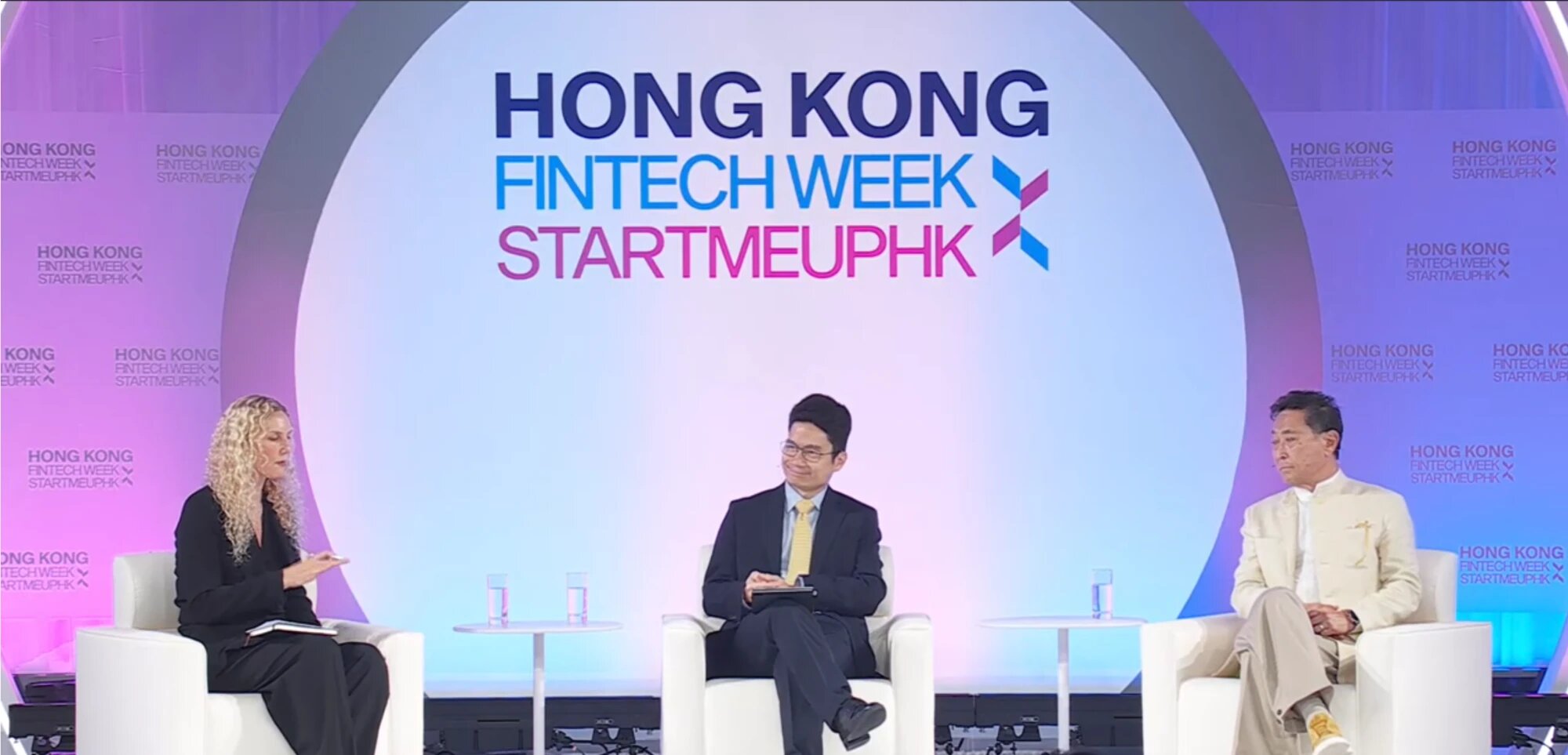
AINI continued its participation in Hong Kong FinTech Week x StartmeupHK 2026. If the first day showed that AI and tokenization have moved from pilots into the real economy, the second raised the next question: who controls the infrastructure and how trust holds up when something fails.
AINI’s agenda on day 2
AINI held bilateral meetings with representatives of government, regulators, fintech companies and law firms.
Federico Lage Cabeza, Consul General of Uruguay in Hong Kong.
Yvonne Tsui, Senior Fintech Director at the Hong Kong Monetary Authority (HKMA).
Matheus Moura, CEO of Avenia.
Olavo Lara Resende, CTO of Nejm e Lara Resende Law Firm.
Marcio Steffen, CEO of HelloMars.
Michelle Lam, CEO of Otto BVI.
These conversations seek to bring Hong Kong and Latin America and the Caribbean closer in regulatory cooperation, payments infrastructure and the regional expansion of fintech solutions. AINI will follow up on each of these connections in the coming weeks.
These are the most relevant announcements and lessons from the day.
Public sector: Hong Kong as a connector
Algernon Yau, Secretary for Commerce and Economic Development, presented Hong Kong as a trusted platform amid geopolitical tensions, inflation and global uncertainty. His Go Global Task Force has already helped more than 360 enterprises from the Chinese mainland set up or expand in Hong Kong. For Latin America he highlighted two facts: the free trade agreement between Hong Kong and Peru entered into force in September, and the government is working toward signing an investment agreement with Peru.
Lillian Cheong, Under Secretary for Innovation, Technology and Industry, described a two-engine model: finance in the south of the city and innovation in the Northern Metropolis. Hong Kong has more than 5,200 startups and about 20 unicorns. Its AI computing capacity will grow from about 5,000 petaflops to 180,000 petaflops by 2032, and the government will create a Commissioner for AI post to coordinate the management of its risks.
Diane Wong, Under Secretary for Environment and Ecology, presented the climate targets of the city’s first five-year plan. Among them is a certification system for green and low-carbon hydrogen by 2027, connecting the standards of the Chinese mainland with those of the rest of the world.
Central banking: monetary sovereignty in the digital era
On behalf of Denis Beau, First Deputy Governor of the Banque de France, Stéphane Latouche set out the European response to two trends: the weight of non-European providers in card payments and the emergence of dollar stablecoins as a settlement asset. The Eurosystem’s strategy is to extend the two-tier monetary system into the digital world. It includes the digital euro, which could be issued in 2029; Pontes, the wholesale settlement service in tokenized central bank money, launched in September 2026; and the Appia project, whose blueprint for tokenized financial infrastructure is expected in 2028.
Capital markets: financing the technology frontier
HKEX, the Hong Kong stock exchange, reported more than 120 listings so far this year, raising more than US$50 billion, which ranks it second in the world by funds raised. It announced the transition to T+1 settlement in the second half of 2028 and the extension of derivatives trading hours to 4:15 a.m. from March, to cover the US close. It also has pilots under way to tokenize carbon credits and metal warehouse warrants.
The chief financial officer of Horizon Robotics explained why technology companies that are not yet profitable choose Hong Kong: listing rules designed for them, weighted voting rights for founders and fast refinancing. He also gave a figure on AI’s effect on the company’s own work: a project that three years ago required 40 people for three months now takes one engineer four hours.
In the panel on family capital, Joseph Chan, Under Secretary for Financial Services and the Treasury, reported that Hong Kong has 3,384 family offices, 25% more than two years ago, and that the city will adopt the ISSB sustainability reporting standards by 2028 at the latest. Frederick Tsao, chairman of TPC, summed up his approach to impact investing.
The higher impact, higher return. If you’re not having higher return, there’s something wrong with the formulation.
AI and work: small teams, agents and new risks
An AI professor at the Hong Kong Polytechnic University, with experience at Google DeepMind and Apple, pointed to the security of AI agents as the main risk without a reliable solution. He also described an organizational shift under way: small teams working with agents can perform like much larger teams, and the middle management layer loses weight.
Crypto: trust under test
Richard Teng, co-CEO of Binance, kept his commitment to speak days after a hack of the platform that the moderator described as the largest in the sector’s history. Teng said the losses are being covered by the SAFU fund and company resources, that user funds were not affected and that the company will publish a detailed analysis of the incident. Since the attack exploited automated transactions, he stressed the need to carefully define what permissions are given to AI agents that handle money. He also described a pattern in emerging markets: young users who previously had no access to US stocks now buy them in tokenized form from US$5, at any hour.
Five lessons from day 2
1. Sovereignty has entered the agenda. Europe is responding to dollar stablecoins with public infrastructure, and Hong Kong is competing by defining standards, from green hydrogen to digital assets.
2. Agent security is the bottleneck. The Binance hack showed the cost of automation without well-defined permissions and controls.
3. AI is changing how companies are structured. Small teams with agents do the work of large teams, and entry-level positions are shrinking.
4. Capital is reorganizing. Exchanges with rules for unprofitable tech companies, public funds that co-invest alongside private capital, and family offices that place impact investing at the center of their mandate.
5. Trust is built before the crisis. Transparency, proof of reserves and governance are what hold an institution up when something goes wrong.
What it means for Latin America and the Caribbean
The free trade agreement between Hong Kong and Peru opens a path to Asia that other economies in the region can watch closely. The Eurosystem’s strategy offers a direct reference for central banks facing dollarization through stablecoins. And the security of AI agents in financial services calls for supervisory frameworks and testing environments before their use becomes widespread, not after.
At AINI, we will closely follow the coming days of the event and share what we learn to accelerate responsible and competitive AI adoption in Latin America and the Caribbean.
Would your organization like to join AINI?
We work with companies, governments, universities and civil society organizations across Latin America and the Caribbean. Let's talk about membership, education partnerships or sponsoring CIAL 2027, in Lima in April 2027.
Become a partner