
News / Announcements / CADE Ejecutivos 2026, day 1: what was said about artificial intelligence
CADE Ejecutivos 2026, day 1: what was said about artificial intelligence
On the first day of CADE Ejecutivos 2026, in Urubamba, Cusco, artificial intelligence came up in the analysis of the world, of the economy and of Peruvian society. The common message: Peru is not going to create AI, but it can adopt it well if it closes its infrastructure and skills gaps.
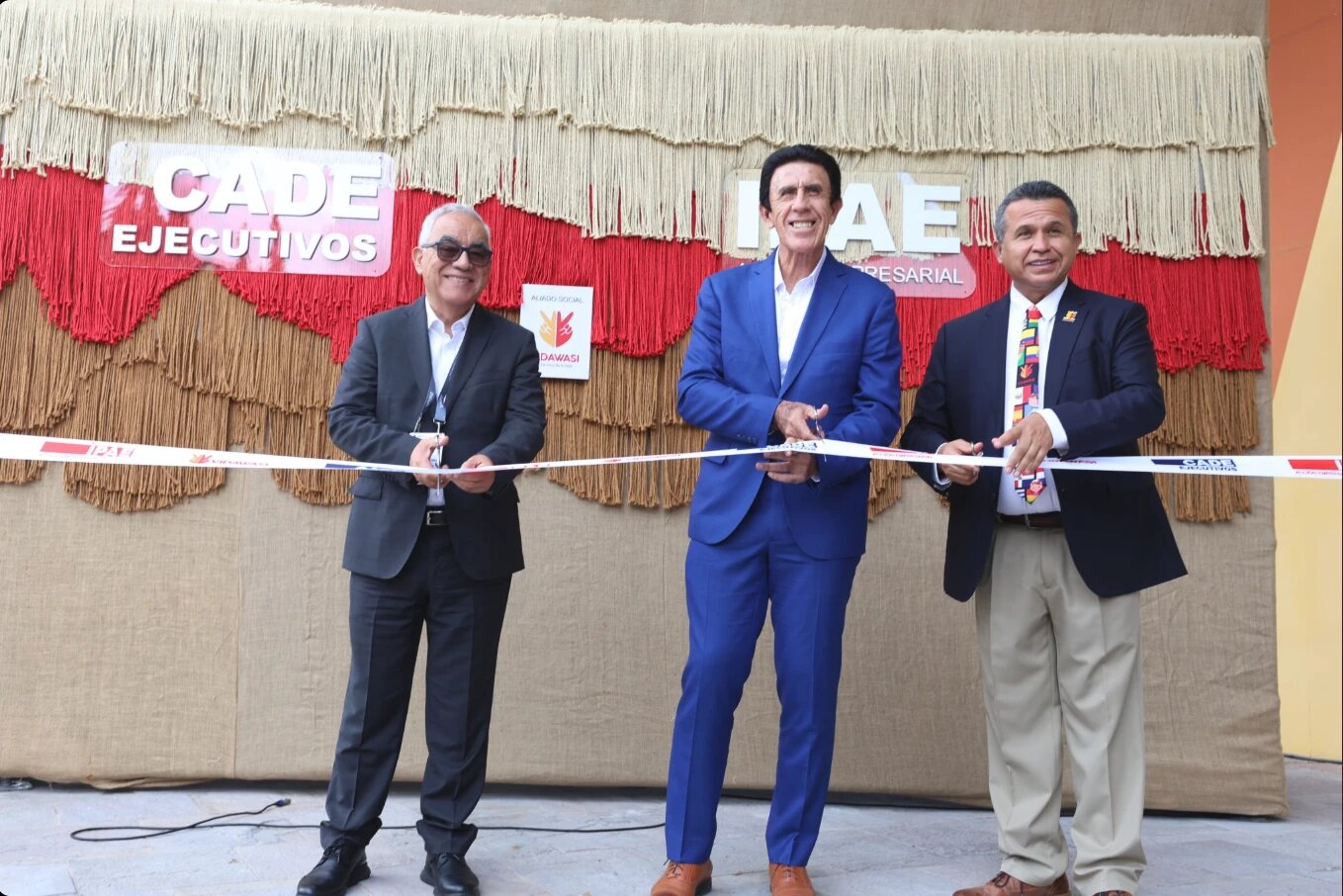
CADE Ejecutivos 2026, the 64th edition of the conference that IPAE Acción Empresarial has organized since 1961, began on November 24. The conference runs until November 26 at the Plaza Yanahuara convention center of the “Virgen de Vidawasi” Children’s Health Citadel, in Urubamba, Cusco, under the motto “United to move forward.”
In his opening remarks, Gonzalo Galdos, president of IPAE Acción Empresarial, listed artificial intelligence among the topics of the three days, along with investment, productivity, the regions and institutions. On the first day, AI did not have a session of its own, but it came up in several presentations. This is a summary of what was said about it and of the most relevant points from the rest of the day.
AI needs what Peru produces
Rolando Arellano Cueva, president of CADE Ejecutivos 2026, opened with a thesis: Peru is living through a unique window of opportunity. He acknowledged that artificial intelligence is going to replace jobs, but pointed out that it does not compete with Peruvian copper: it needs it to function.
Núria Vilanova, president of the Ibero-American Business Council (Consejo Empresarial Alianza por Iberoamérica, CEAPI), developed the same idea from a geopolitical angle, in the day’s keynote, moderated by Fernando Zavala, general manager of Intercorp. She spoke of an AI race in which securing minerals, food and energy has become strategic, and in which Ibero-America has much of what the world is looking for. What it lacks, she said, is the influence that matches that power.
Robots, data centers and a factory in the dark
Vilanova warned that there is a lot of talk about AI and little about robotics. According to her, China already has as many robots as children, and it is estimated that in four years there will be 4 billion robots in the world. She described the case of a large Spanish company whose factory in Portugal is so robotized that they debated whether it made sense to keep the lights on: robots do not need them.
She also gave an example of how a company can reposition itself in the AI economy. She said that the Spanish construction company ACS, known for its highways, offered the large technology companies to build their data centers and that today, according to Vilanova, it is the company that builds the most data centers in the world. Her conclusion for companies: ask themselves what they know how to do, not what they have done so far.
Zavala added the context of speed: ChatGPT reached one million users in five days, and the previous week there were cyberattacks against airports and large banks in the United States. His reading: rather than predicting the future, one has to prepare for several possible scenarios.
Showing up in AI’s answers
For companies, Vilanova left a concrete warning. More and more decisions begin with a question to an artificial intelligence assistant, and its answers do not feature the most important companies, but those that worked to be there. That is why she called for working on that positioning, and for being not just well known, but relevant.
She added a risk: AI and robotics are going to change the workforce and bring more conflict, along with more fake news and images that are not real. In that environment, she said, reputation is a strategic asset that has to be worked on like never before.
Adopt, not create: the two conditions
Alvaro Monge, general manager of Macroconsult, cited a report the World Bank published in August on how developing countries can join the wave of artificial intelligence. He drew two lessons from it. The first: developing countries are not going to generate AI; what they can do is adopt it as quickly and efficiently as possible. The second: to do so they need two conditions, infrastructure and skills. If it meets them, he said, Peru will not watch the party from the window, as in previous technological revolutions.
Monge made clear why skills are the weak point. He showed anemia at 35%, that only about 10% of students reach adequate learning in mathematics and reading, and that labor informality stands at around 73%. According to the World Bank, he cited, about 7% of the difference between high- and low-productivity countries is explained by nutrition. An important part of the game, he concluded, is played in the first thousand days of life.
AI as a tool to listen to Peruvians
Rolando Arellano Bamonte, executive director of Arellano Consultoría para Crecer, showed a concrete use of AI. His study on “the Peruvian dream” was based on 1,210 in-person household interviews with people aged 18 to 70, in urban and rural areas of the country’s five regions. The team used artificial intelligence to process that large number of conversations, find the patterns behind that diversity and cross them with its previous studies. With those answers it also created characters, such as “María” and “Pepe,” who voice what the interviewees say.
The central finding: the Peruvian dream is about the family and is concrete —housing, education, one’s own business— and it seeks both to move forward and to protect what has already been achieved. 83.5% believe they will achieve their personal dream, but only 49% believe the country they dream of will be achieved. And only three in ten Peruvians recognize that companies help fulfill their dreams.
The rest of the day
Society. Franco Olcese, founding partner of Centro Wiñaq, described a Peru that is conservative, increasingly optimistic and entrepreneurial, but warned that some people no longer want to start a business for fear of extortion.
Economy. Monge projected poverty at 26.5% in 2027, about three points above the path without the current shocks, among them an extraordinary El Niño event.
Politics. Oscar Reto, president of Peru’s Chamber of Deputies, spoke with journalist Fernando Carvallo and acknowledged that the two-chamber Congress has not yet met its goal of rebuilding citizens’ trust.
Vision for 2050. Pablo Bustamante, past president of IPAE Acción Empresarial, presented a vision of Peru at mid-century as a work agenda for citizens, companies and governments.
Shared value. In the Empresas que Transforman (Companies that Transform) session, moderated by Malena Morales, Patricia Gastelumendi, of Ferreycorp, explained how Ferreyros has trained more than 2,000 young people as heavy machinery technicians with Tecsup. Paul Gómez, of Gold Fields, explained how community companies near the Cerro Corona mine became its suppliers. Alejandro Pérez-Reyes, general manager of Mibanco, presented the Grand Prize to Yape for its initiative “Conectando oportunidades” (Connecting opportunities).
Government. Angello Tangherlini, minister of Transport and Communications, in conversation with Rosana Cueva, of América Multimedia and Canal N, presented the government’s five pillars, among them a digital anti-corruption shock to publish all tenders, contracts and addenda in real time, and the infrastructure portfolio in the face of El Niño.
Four ideas on AI from day 1
1. AI is also raw material. It needs copper, minerals and data centers. Arellano and Vilanova presented this as an opportunity for a mining country like Peru.
2. The region is going to adopt, not create. According to the World Bank report Monge cited, the advantage will not lie in developing models, but in adopting them quickly and well.
3. Skills are the bottleneck. Without human capital —from child nutrition to school learning—, infrastructure is not enough.
4. Reputation is now at stake in AI’s answers. According to Vilanova, those answers feature the companies that worked to be there, not necessarily the most important ones, and reputation must also be protected against disinformation.
AINI’s view
Investment in the large artificial intelligence labs is concentrated today in the United States and China. On November 19, Anthropic began trading on the Nasdaq. DeepSeek, which until this year had not received outside capital, closed two rounds in 2026 that, according to Reuters, add up to more than US$22 billion. AI’s physical supply chain is also concentrated: the most advanced chips are made in Taiwan, the lithography machines that make them possible come from the Netherlands, and much of the memory comes from South Korea.
Arellano said it at the opening: AI needs Peruvian copper. For AINI, that is where the risk lies: that Peru sells the raw material of artificial intelligence and buys the intelligence ready-made, as a foreign service. Monge is right that the region is not going to compete with those labs. But adopting does not have to mean only buying.
Between creating frontier models and buying them there is a middle path, and the region already has some of its pieces.
Infrastructure. Lima has 14 data centers in operation, according to the consulting firm Binswanger, and GTD’s in Lurín is designed for 20 MW. The challenge is for that capacity to also serve to run and adapt models in the country.
Open-weight models. They make it possible to download a model, adapt it with one’s own data and run it on one’s own infrastructure. Latam-GPT, presented on February 10, 2026 in Santiago, Chile, and coordinated by CENIA, is the region’s first large open language model. Peru formally joined the project through the Secretariat of Government and Digital Transformation of the PCM, and its pretraining is led by Peruvian researcher Omar Flórez.
Rules. The regulation of Law No. 31814, approved by Supreme Decree No. 115-2025-PCM, set September 10, 2026 as the first compliance deadline for sectors such as health, education, justice, security, and economy and finance.
For AINI, the priority is for Peru to build its own capabilities: data centers, talent able to adapt open models, and applications tailored to public services —health, education, housing and justice—, trained with the country’s data and languages. If intelligence is only bought from abroad, the value it generates, the data that feeds it and the decisions on how it works remain outside the region, and technological dependence is added to dependence on raw materials. It is the same underlying question this CADE raised: how to turn the country’s wealth into development for all its citizens.
Would your organization like to join AINI?
We work with companies, governments, universities and civil society organizations across Latin America and the Caribbean. Let's talk about membership, education partnerships or sponsoring CIAL 2027, in Lima in April 2027.
Become a partner