
News / Announcements / CADE Ejecutivos 2026, day 2: what was said about artificial intelligence
CADE Ejecutivos 2026, day 2: what was said about artificial intelligence
The second day of CADE Ejecutivos 2026 was devoted to the regions and the new global order, and artificial intelligence barely came up. When it did, it was in concrete uses: detecting lung cancer remotely in Cajamarca, tracking human trafficking cases in banking and setting up a territorial data center in Cusco.
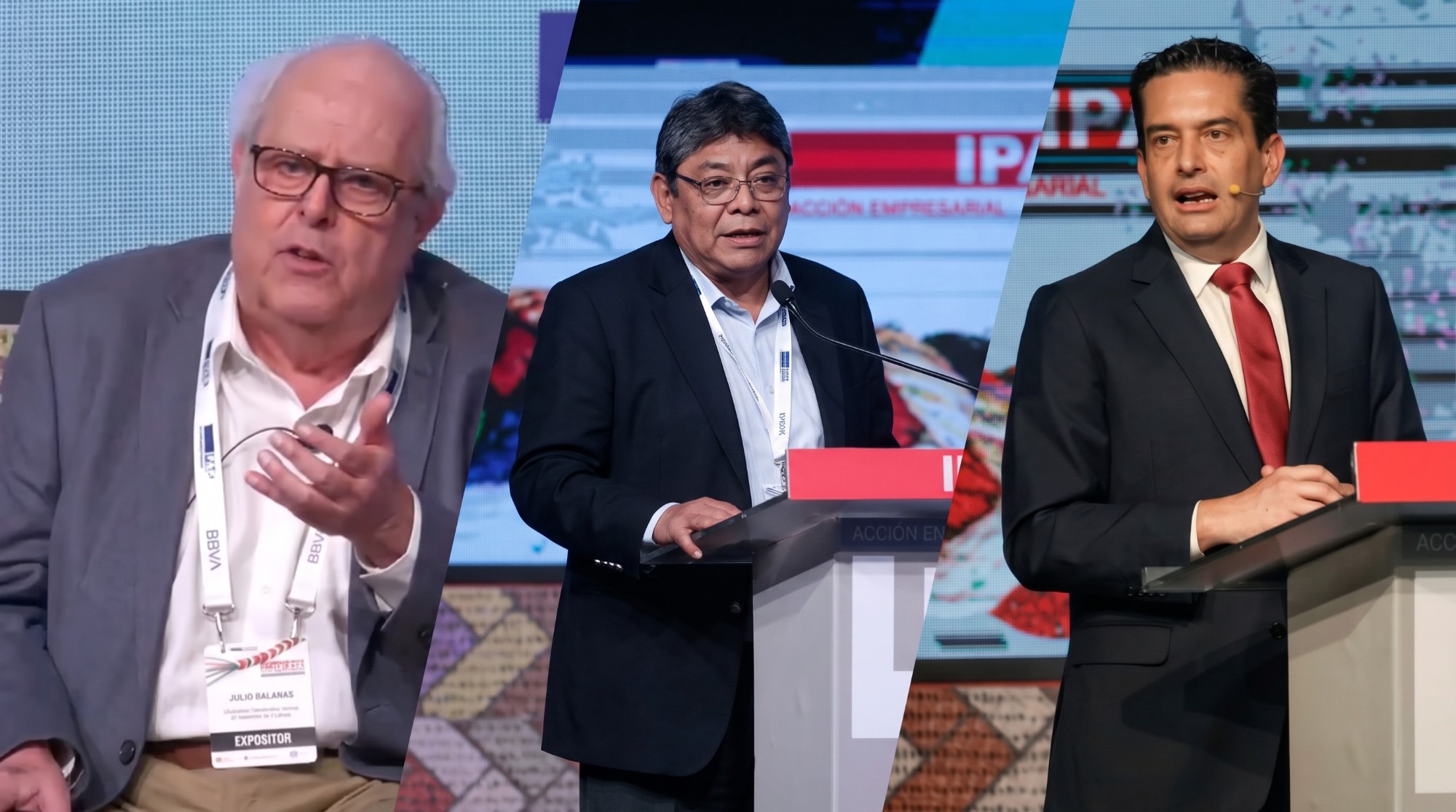
On November 25, CADE Ejecutivos 2026 held its second day in Urubamba, Cusco. The program was divided into two blocks: “Growing from the regions,” in the morning, and “Growing in the global world,” in the afternoon. No session was devoted to artificial intelligence, and the few times it was discussed it was to describe use cases, not trends. This is a summary of those mentions and of the most relevant points from the rest of the day.
Early diagnosis at a distance
In the panel on essential sectors, moderated by María Isabel León, Ángela Flores, president of the Strategic Health Committee of IPAE Acción Empresarial and executive director of ALAFARPE, said that some companies are already bringing telemedicine to Cajamarca with artificial intelligence to detect lung cancer in time. According to Flores, this makes it possible to diagnose better and to avoid catastrophic costs for the patient later on. She used the case to ask local and regional governments to prioritize health, and noted that Cusco manages 1,064 million soles in resources.
Algorithms against human trafficking
In the session on alliances between companies, regions and the State, moderated by Rosa Asca, Sebastián Arcuri, CEO of Scotiabank Peru, described a mechanism for sharing information between the public and private sectors on banking-related crimes. According to Arcuri, the bank brought algorithms from Canada to detect human trafficking cases, and with them more than 33 cases now under investigation have been identified. His argument: crimes change their form, and the private sector can contribute the technology and the capacity to adapt.
A data center for the territory
In the governors’ panel, moderated by Luis Carranza, Verónika Mendoza, governor-elect of the Cusco region, announced that her administration will build a territorial data intelligence center. The idea is to bring together information from the central government, the regional government, local governments and the private sector in order to make evidence-based decisions; for example, to anticipate or respond in time to the impacts of the El Niño phenomenon. To achieve this, she asked for the private sector’s involvement in infrastructure, technology and information.
Adapt, not invent
In the closing session, moderated by Diego Macera, director of the Peruvian Institute of Economics (Instituto Peruano de Economía), the minister of Economy and Finance, Elmer Cuba, cited Philippe Aghion’s model of growth through creative destruction; Aghion received the 2025 Nobel Prize in Economics. His reading for Peru matches that of day 1: developing countries do not develop the technology, but they have to adapt it. As examples of that adaptation he cited gastronomy, blueberry varieties grown in the desert and mining.
Cuba also pointed to the limit. In what he called the world of technology and information, the main risk for the Peruvian economy, he said, is education, not bureaucracy or paperwork. He cited that only 30% of fourth-grade children pass the learning assessments for their grade, and 32% in mathematics. We keep producing poor and vulnerable people, he said.
The rest of the day
Decentralization. Sergio Díaz-Granados, executive president of CAF —development bank of Latin America and the Caribbean—, spoke with Paulo Pantigoso about the Colombian experience. His conclusion: laws have to be built on the facts, not the other way around.
Public investment. Antonio Cusato, an economist at the World Bank, measured how far projects have progressed four years after they start. That progress fell from about 80% to around 65% after the public investment system was made more flexible, and by that measure the gap between the national government and subnational governments is smaller than annual budget execution suggests.
Open finance. Drago Kisic, founder of Macroconsult, asked Julio Velarde, president of the Central Reserve Bank, about the open finance scheme promoted by the BCRP and the SBS, under which a customer’s information will be able to move from one bank to another if the customer asks for it. Velarde saw it as positive for competition: the data, he said, belongs to the customer, not to the bank.
Tourism. Luis Padrón, president of the Council of Chambers of Commerce of the Canary Islands, presented the Canary Islands’ experience in the session moderated by Juan Stoessel and Erika Sandi.
Politics. Miguel Ángel Torres, president of the Senate and of the Congress of the Republic, spoke with Fernando Carvallo about the country’s new political balance.
Economy. Cuba estimated that political instability costs Peru between 2 and 2.5 points of per capita growth, and presented the goal of lowering labor informality from 70% to about 48%, the regional average.
Three ideas on AI from day 2
1. AI arrived as a tool, not as a topic. Health, financial security and regional management: the three cases are concrete uses, not promises.
2. Data comes first. The Cusco territorial center and the information sharing against trafficking both start from bringing together data that is scattered today.
3. The ceiling is still human capital. For Cuba, as for Monge on day 1, adapting technology requires an education system that does not support it today.
AINI’s view
Open finance. The open finance system is moving forward in Peru with a public roadmap. The SBS, which is driving it together with the BCRP, published its roadmap in February 2026 and the diagnosis and guidelines in July, and set up an advisory group in September. In October it added the schedule for the mandatory onboarding of entities and the draft general regulation, which was open for comments until November 6. As was said at the conference, customer information becomes the customer’s, not the bank’s. Making that information available to new market players could give rise to financial products and services that better meet the needs of families and businesses.
MAPE Law. Miguel Ángel Torres, president of the Senate, recalled at CADE that the government submitted in early October a bill on small-scale and artisanal mining (Ley MAPE, the MAPE Law). He also recalled that on November 10 the deadline for the Chamber of Deputies to issue its committee report expired without that happening. The Executive expects the bill to be approved, and CONFEMIN, an association of small-scale and artisanal miners, has called a march for December 1. On November 25, the Colectivo PAS – País Seguro (Safe Country Collective), which brings together more than 50 business associations and institutions, called on Congress to approve without further delay a MAPE Law with defined deadlines, verifiable environmental and social requirements, traceability and effective oversight. It also called for no further extensions of the REINFO, the Comprehensive Registry for Mining Formalization, whose final expiration date is December 31, 2026. AINI endorses that call.
Institutional trust. The announced digital anti-corruption shock and the Ministry of Economy and Finance’s plan to reduce tax evasion point to something the private sector needs: to regain trust in public institutions, an essential foundation for building a better society. According to Elmer Cuba, evasion of the general sales tax (IGV) and of corporate income tax amounts to 9% of GDP, compared with a regional average of 6.7%. For AINI, political stability is one of the conditions that weigh most on growth. Cuba himself estimated that political instability costs Peru between 2 and 2.5 points of per capita growth. If President Keiko Fujimori’s government achieves five years of stability, the country will be in a better position to reach the growth the MEF projects: 4% a year from 2028 in the Multiannual Macroeconomic Framework, with the goal of exceeding 5% midway through the term. For the 2026-2030 period as a whole, the projected average GDP growth is 3.8%.
Would your organization like to join AINI?
We work with companies, governments, universities and civil society organizations across Latin America and the Caribbean. Let's talk about membership, education partnerships or sponsoring CIAL 2027, in Lima in April 2027.
Become a partner