
News / Announcements / CADE Ejecutivos 2026, day 3: what was said about artificial intelligence
CADE Ejecutivos 2026, day 3: what was said about artificial intelligence
The last day of CADE Ejecutivos 2026 had the only session devoted to artificial intelligence. Its message: using AI is not the same as getting value from it, and the difference comes from leadership, the redesign of work and trust, in companies and in the State alike.
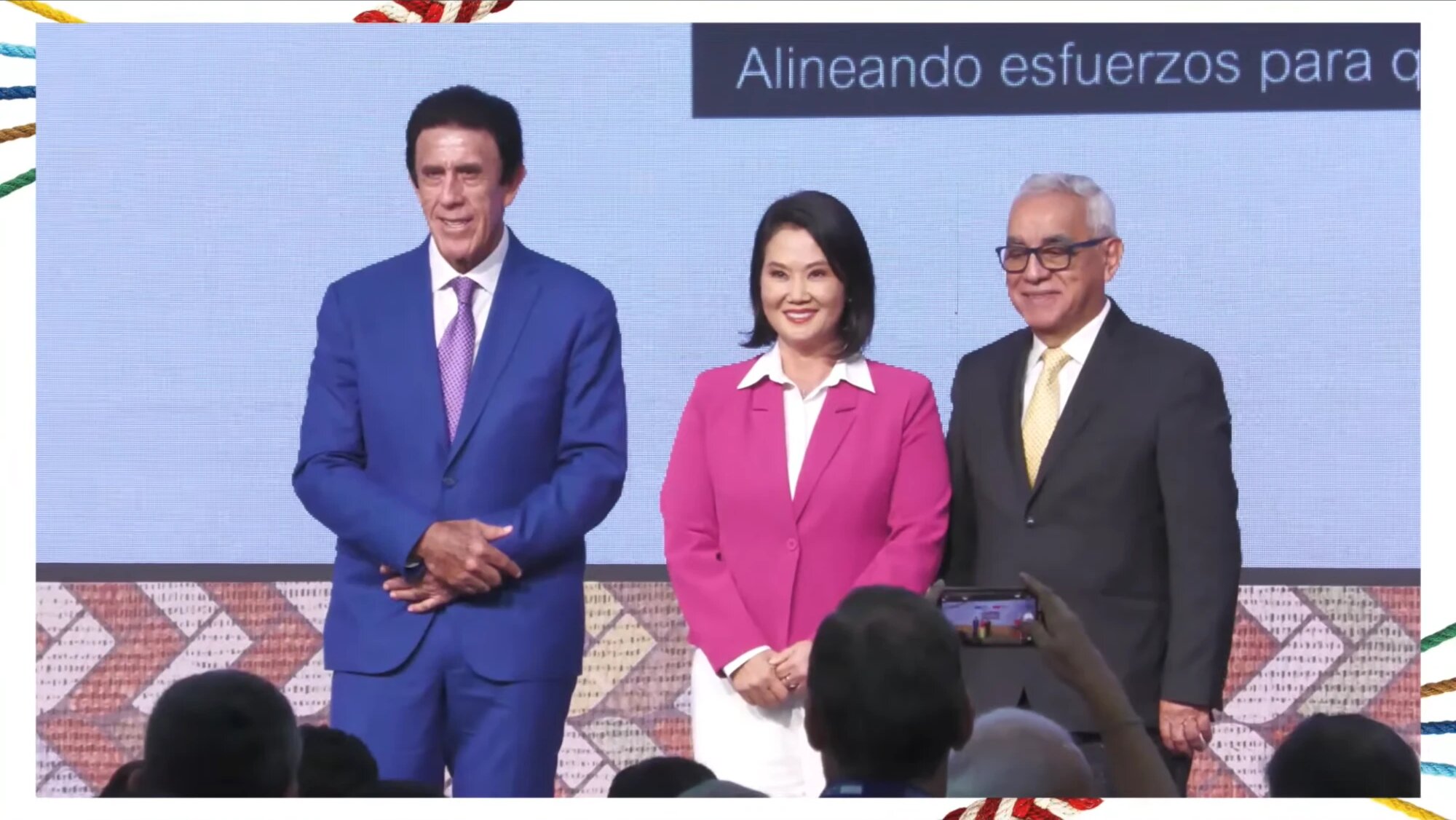
On November 26, CADE Ejecutivos 2026 closed its 64th edition in Urubamba, Cusco, with the “Moving forward united” block, devoted to how to coordinate companies, regions and the State. Unlike the two previous days, artificial intelligence had a session of its own, held in English with simultaneous interpretation. This is a summary of what was said in it, of the other mentions of AI and of the most relevant points from the rest of the day.
Using AI is not the same as getting value
The session, moderated by María Rosa Villalobos, editor of the Economy and Día1 section of the newspaper El Comercio, began with Víctor Laguna, co-founder and CEO of PathPilot, a company of AI agents for credit and collections, who worked for almost fifteen years in Silicon Valley. According to the figures he presented, one in three companies in Peru says it has implemented some artificial intelligence solution, but only between 7% and 8% apply it fully. In Latin America, he added, only 6% of institutions report having obtained significant value from it. His conclusion: adopting AI for its own sake does not create value.
Brooke Weddle, senior partner at McKinsey & Company, reached the same point with global figures. In 2025, according to the firm’s research, 88% of organizations used AI in at least one function, but more than 80% saw no tangible impact at the level of the organization as a whole. Those that do capture value, she said, stand out because they redesign their processes and their operating model, instead of just adding AI to what they already did.
Three phases for companies
Laguna proposed adopting AI in three phases. The first, people: giving employees access to AI tools, in their enterprise versions to better control data. He estimated savings of around four hours a week, and much more in some roles. In software, he said, the difference is greater: he said he does not remember writing code in the last twelve months, although he does remember correcting the code that AI generates. The second phase, processes: identifying the critical processes that are worth optimizing, a task for those who work on them every day. The third, the user experience, which is only worth transforming once the other two are mature.
To illustrate the phases he cited cases such as Blue River, the US company co-founded by Peruvian Jorge Heraud, which trained AI models to identify weeds and apply herbicide only where needed, and Nubank, which according to him automates between 60% and 70% of its customer service without sacrificing the user experience. He also mentioned Félix Pago, which sends remittances to Latin America over WhatsApp with AI agents. He closed with a recommendation from Silicon Valley: experiment, knowing that out of every ten attempts only one or two will produce the desired result.
AI in the State
Weddle devoted her presentation to the public sector. She mentioned examples such as Brazil, where the government applies generative AI to case notes from the tax administration, and Singapore, where public officials created some 60,000 agents to support their work. According to McKinsey, 55% of public-sector work hours are technically automatable, although most jobs would not disappear: 73% fall into a middle zone that requires redesigning the role.
She described three ways of dividing work between people and agents. In the first, human-led, AI gathers the documentation for a complex permit application and prepares a recommendation, but a public servant decides. In the second, agent-led, AI checks routine documents and refers unusual cases to a person. In the third, fully agentic, it completes standardized transactions, such as a permit renewal, within fixed rules, while humans oversee the system and handle the exceptions. In her view, the question is not how much AI can automate, but where human involvement adds the most.
For Peru, she presented a McKinsey analysis that groups occupations into seven archetypes according to how their work would be divided among people, agents and robots. Nurses and general managers have tasks in which AI helps without replacing the role; secretaries, administrative assistants and accountants are more exposed, because of the weight of information processing; and in occupations such as agricultural operator, cook or truck driver, what matters is robotics. That potential, she warned, should be read as an opportunity to reorganize work, not as a prediction of how many jobs will be lost.
Weddle added the requirements specific to the public sector: accountability, transparency, fairness and public trust, which weigh more when systems carry out several actions on their own. Among the risks she listed were algorithmic bias, unclear accountability, data security and privacy, and a regulatory framework in constant change.
Trust as a predictor
In the conversation, Weddle said that, according to McKinsey’s research, trust, both individual and organizational, is one of the best predictors that an organization will capture value from AI. To build it she proposed four steps: building capabilities, having leaders set the example by using AI, starting communication with the why of the change, and reinforcing it with incentives and performance evaluation. She also said that leading organizations treat each use case almost like a venture capital investment: an initial budget to experiment and more resources only if value appears.
Laguna agreed that trust is earned by using the tool, and added a practical warning: AI makes mistakes, so one of the most valuable skills today is detecting in time when it does. Asked how to control it, he argued for keeping a person in the loop to review, approve and verify. He gave his own example: he has AI connected to answer emails, but if the reply goes to a client, he must approve it first.
AI on the IDB’s agenda
Before the session, Ilan Goldfajn, president of the Inter-American Development Bank (IDB), in conversation with Rosanna Ramos-Velita, chair of the board of Caja Los Andes, included digital transformation and artificial intelligence among his five pillars for raising productivity. He said the IDB Group is working for the countries of the region to adopt AI safely and productively. He also said he visited in Urubamba a project with RENIEC so that every Peruvian has an electronic and then a digital identity, and recalled that in Brazil the Pix payment system, whose development began when he headed the Central Bank of Brazil, reached 50 million people.
The rest of the day
Financing. Goldfajn announced that the IDB Group will make US$10 billion available to Peru over the next four years, US$4 billion of it through IDB Invest, its private-sector arm: as much as IDB Invest did in the country over the last ten years. He also mentioned an investment of up to 2 billion to build and rehabilitate schools, which would benefit some 250,000 students, and US$400 million in contingent financing to make resources quickly available in the face of El Niño.
IPAE Award. Juan Stoessel, CEO of Casa Andina, received the 2026 IPAE Award, and Fernando Barrios, founder and president of Universidad Continental, the regional entrepreneur award. The company distinctions went to Siderperú, AJE Group and BCP.
Legacy. Juan Fernando Correa, founder of Jaxa Consulting, and Karina Málaga, vice president of IPAE Acción Empresarial, presented this edition’s legacy in the Sacred Valley: fighting anemia among babies aged 6 to 11 months, which according to them affects half of them in the country, and a community plaza in the Yanahuara annex.
Conclusions. Rolando Arellano Cueva, president of CADE Ejecutivos 2026, summed up the three days as realistic optimism and as three requests to the State: stable rules, speed and better use of its resources. He cited an example heard at the conference: in mining, in ten years the number of procedures went from 12 to more than 400 to obtain the same results.
Government. The president of the Republic, Keiko Fujimori, spoke of a tangle of procedures that holds back public and private investment. She announced the addendum to expand the natural gas network in seven of the country’s regions, with the commitment to connect more than 300,000 households, and asked Congress to debate and approve the MAPE Law: in 14 years, she recalled, the REINFO has been extended five times.
Closing. Gonzalo Galdos, president of IPAE Acción Empresarial, closed the conference with a question to business leaders: what they are willing to change in themselves to live up to the country they want to build.
Three ideas on AI from day 3
1. Adoption is not impact. Laguna’s and Weddle’s figures point to the same thing: almost everyone uses AI, few get value from it, and the difference lies in redesigning work.
2. The State is a use case. Reviewing applications, checking documents and renewing permits are tasks that AI agents can already support, with public servants in charge of decisions and exceptions.
3. The transformation is about leadership. For both speakers, trust, leaders’ example and human oversight weigh as much as the technology.
AINI’s view
President Keiko Fujimori was emphatic at CADE: she said she has not fought for 15 years of her life and faced four electoral processes to sit back and do nothing. She said she has come to make decisions, with the mandate Peruvians gave her and within a democracy in which not everything she asks for is granted: the delegation of powers to reform the State did not come in the terms the Executive requested.
For the pending decisions, the Executive has within its reach the question of confidence before the Chamber of Deputies, which it could use to push for the approval of the MAPE Law and of other important reforms, such as the public investment reform and the Ministry of Economy and Finance’s plan to reduce tax evasion. For AINI, these signals are restoring the private sector’s confidence. If the plan moves forward, 2027 could be a year of strong momentum for private investment, both local and international. One sign is the Perú Hub Digital meeting, to be held on Wednesday, December 2 to promote investment in data centers and connectivity.
Business confidence is already moving. In the Ipsos Perú survey for CADE Ejecutivos 2026, conducted from November 5 to 15 among 292 CEOs and senior executives of the country’s 5,000 largest companies, 60% consider that the country is progressing, twice the share in 2025 and the highest in the last decade, and 41% increased their investment plans since the election of the new government. If the political stability of a five-year government is added to that confidence, the country would be in a better position to reach the growth the MEF projects and to bring more development to all Peruvians. For AINI, three enablers will make the difference over the next five years: more technological infrastructure, better digital skills and better access to investment. AINI wants to support that path and contribute to the growth goal of Peru and the region.
Would your organization like to join AINI?
We work with companies, governments, universities and civil society organizations across Latin America and the Caribbean. Let's talk about membership, education partnerships or sponsoring CIAL 2027, in Lima in April 2027.
Become a partner