
News / Policy / AI now finds cybersecurity flaws: PHP2Shell and Latin America’s response
AI now finds cybersecurity flaws: PHP2Shell and Latin America’s response
On October 21, 2026, PHP —the language that powers 70% of websites worldwide, according to Wiz Research— patched vulnerabilities that allow unauthenticated remote code execution. Colombia, Brazil, Chile and Peru issued alerts that same day, and the vulnerabilities published in a single month of 2026 already nearly triple the peaks of previous years.
On October 21, 2026, Japan’s Prime Minister Sanae Takaichi posted on her X account a request of utmost urgency: to check whether websites use PHP and to prepare to apply as soon as possible the security patch due to be released that night.
On October 21, 2026, PHP —one of the programming languages websites run on and, according to Wiz Research, the language that “powers 70% of all websites in the world”— released the patch for several security vulnerabilities, known as “PHP2Shell” and grouped under two identifiers, CVE-2026-109618 and CVE-2026-109619. According to Wiz Research, which says it used AI tools throughout the research, “Every PHP version released in the last decade is affected by at least one of these vulnerabilities”, and the impact includes unauthenticated remote code execution.
The impact of PHP2Shell in Latin America
In Colombia, ColCERT, the country’s incident response team, published on October 21 the critical alert “COLCERT AL – 20261021 - 123”, with a high risk level. According to the alert, the two vulnerabilities have a severity of 9.2 on the CVSS v4.0 scale, are exploited with an unauthenticated web request and affect every PHP installation that serves web requests; an attacker who manages to execute code obtains the web server’s privileges and access to the application’s databases, credentials and files. ColCERT called for updating immediately to the patched versions and warned that there is no complete mitigation: updating is the only complete solution.
The alert includes the country’s exposure. According to a Shodan query run by ColCERT on October 21, there are 8,699 internet-exposed services running PHP in Colombia, and 88% of them are on internet service provider and telecommunications networks, where the server may belong to any client organization or company. ColCERT notes that the figure indicates potential exposure that must be confirmed on each server.
Also on October 21, Brazil’s CTIR Gov published Alert 93/2026 on the two vulnerabilities, which reminds the bodies of the Federal Cyber Incident Management Network (ReGIC) that they must remediate them urgently, under Decree No. 10,748/2021. That day the National CSIRT of Chile’s ANCI published alert AVC26-00740 and asked organizations that use PHP to update immediately. In Peru, the National Digital Security Center of the Presidency of the Council of Ministers alerted some 2,400 security and technology officials at 1,510 public entities on October 21, and asked them to check whether they use vulnerable versions of PHP, install the updates and step up monitoring of internet-connected systems.
More and more vulnerabilities published
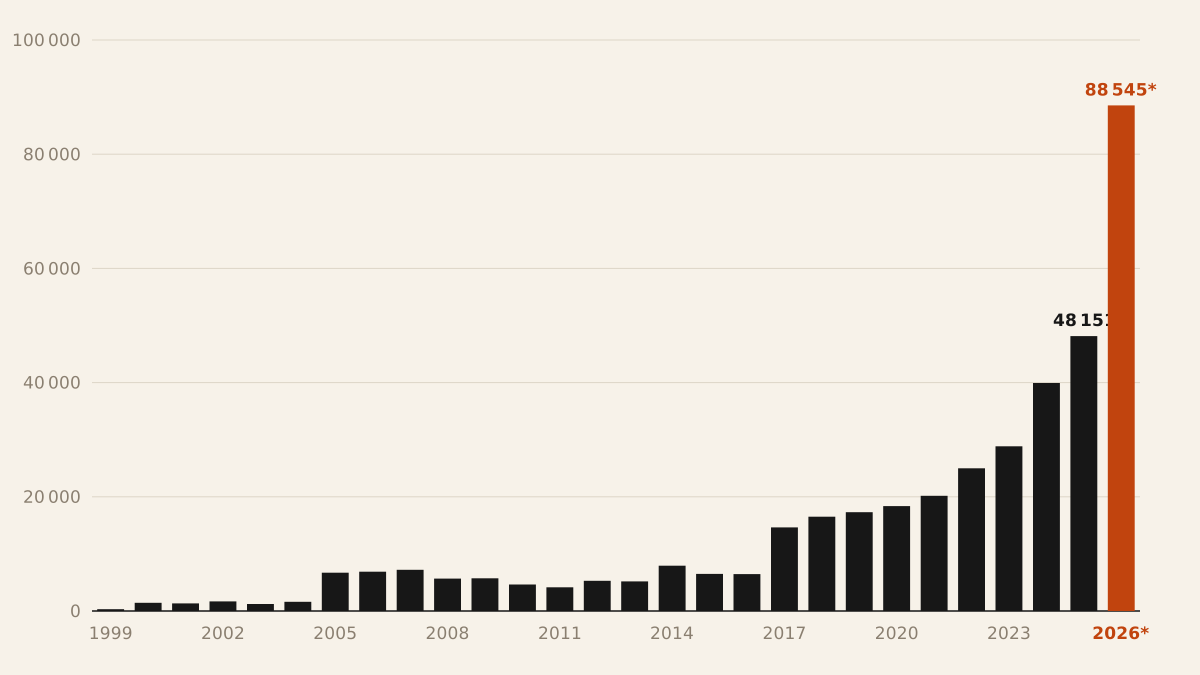
The pace at which vulnerabilities are published has also changed. According to the CVE Program’s records (the CVEProject/cvelistV5 repository), counted by AINI by publication date and excluding rejected records, 88,545 CVEs were published between January 1 and October 28, 2026, compared with 48,151 in all of 2025 and 39,924 in 2024. In September 2026 alone, 14,934 were published, and in October, through the 28th, 15,744; before 2026, no month had exceeded the 5,493 of December 2025. The records do not indicate the cause of the increase.
AINI’s view
The CVE Program’s records show that in 2026 vulnerabilities are being published at a pace that nearly triples the monthly peaks of previous years. For AINI, one possible explanation is the growing use of artificial intelligence models, which help cybersecurity teams find flaws faster and faster: Wiz Research, for example, says it used AI tools throughout its research on PHP2Shell.
The governments of Colombia, Brazil, Chile and Peru responded in time: on the same day the patch was released, they alerted their public organizations and recommended that they check which systems use PHP and apply the update immediately.
In Peru, on that same October 21, Directive No. 002-2026-PCM/SGTD was published in El Peruano, setting out the profile and responsibilities of the Artificial Intelligence Officer in public entities. Among its functions is coordinating with the Digital Security and Trust Officer the review of the National Digital Security Center’s digital security alerts that apply to the entity’s artificial intelligence systems. The directive did not arise from PHP2Shell —it was signed two days earlier—, but it aims at the same thing this case put to the test: that every alert reaches someone responsible for acting on it.
If the 2026 pace holds, the question for the region is whether its organizations can inventory and patch at the speed at which vulnerabilities are published.
Would your organization like to join AINI?
We work with companies, governments, universities and civil society organizations across Latin America and the Caribbean. Let's talk about membership, education partnerships or sponsoring CIAL 2027, in Lima in April 2027.
Become a partner